11.04.2010

RIP Andy Irons


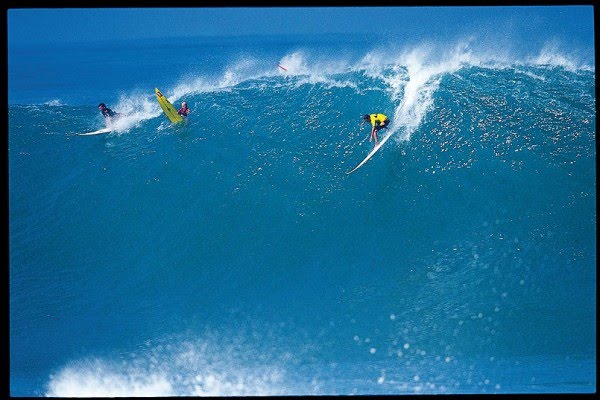
Andy Irons was a three-time ASP world champion surfer. He was born in 1978 on Kuai, Hawaii. He briefly retired from the sport before rejoining the ASP World Tour this year. After a slow start to 2010, he picked up a win at the Billabong Pro Teahupoo and looked to be making his way back before disappointing finishes at the European ASP events in France and Portugal.

While waiting for swell at the current ASP event in Puerto Rico, Irons apparently contracted dengue fever and was on his way back to Hawaii when he was deemed too ill to travel after a layover in Dallas. He was later found dead in his hotel room. Currently police are investigating whether an adverse reaction to medication was partially to blame, as there were prescription drugs in his room.

I don't really have much more to say about his professional career or anything; he was a great surfer who was respected for his powerful style and competitive fire, and there's a ton of tributes in words, video, and pictures at places like Surfer Magazine and the ASP tour site.

I always found myself fascinated more by his well-documented 'dark side.' He famously walked away from the lucrative professional tour last year for what were widely suspected to be drug-related reasons. Irons himself, however, told a story of competitive burnout and lack of desire, which is the story I bought into.

Drugs are easy to blame, and the human mind is a far more complex and changeful thing than we will ever fathom--not unlike the ocean itself. Some people are at the mercy of their own mind in ways that could never be explained in words to someone who doesn't endure the same torment; the same battering swell every day of their lives. For people like that, drugs are an end, not a beginning.

Anyway, I remember reading an interview with him last spring where he discussed his decision to leave the sport, and it resonated with me for a number of reasons, not the least of which was a recent step away from my own professional field. His story interested me on a personal level, and that was moving, in a way, since I had always admired him as a surfer. I felt engaged by his ordeal.

I kept tabs on him, and found myself pleased when he decided to come out for the tour again. It is a hard enough decision to walk away from the job that makes your name, but it must be torture when you decide to come back--especially given the media focus one attracts as a professional athlete. The video I posted above is pretty much all you need to know about how he was handling his return to competition.

Andy is survived by his wife, unborn child, parents, and brother Bruce who is also a pro surfer. I offer them my condolences, and for myself, I really hope it wasn't drugs.
11.02.2010

Out of Print

Here's a sample from a really amazing line of shirts by Out of Print, a graphic design company that re-imagines out of print book covers on t-shirts and sweatshirts.

The really exceptional part of what they do, however, is their partnership with Books for Africa, which is a charity that collects books and sends them to...Africa. Right. Anyway, the sentiment and execution combine to make a truly fantastic opportunity to sport your literary pedigree, acquire a 100% distressed cotton tee, and give children in Africa access to great literature all in one fell swoop.

Tees are $28 ($22 for kids) and sweatshirts are $38 here.


via coolhunting

11.01.2010

Boracay: a Brief Travelogue (Part 3)

[ED: This is part 3 of an indeterminable-part series on the island of Boracay.]

In order to get from the noisy jetty port at the southern tip of Boracay to the air-conditioned bungalows on White Beach, a traveler such as myself must either brave the sweltering backwoods roads on foot, hike around the rocky shore to the southern tip of the beach, or secure a licensed Filipino to drive him. A traveler such as myself will choose the third option.

The only mode of land transport for a true backpacking impostor is the tricycle. This is basically an aluminum cart/sidecar welded on to a 50cc dirt bike running on bald street tires and watered down petrol. Top speed ranges from 2 to 15 miles per hour depending on the grade, and if you’re taller than 5’2” you’ll want to diligently brace your arm against the tin canopy and iron support frame or you could find yourself unconscious after a downhill pothole or flat on your ass in the street if you’re going up.

While you attempt to find someone to drive you, you will be accosted by people who want to sell you a place to stay. If you don’t have a place and have a knack for bargaining, you might want to try this out. If nothing else, you will have your interests zealously pursued by the man/woman who has attached him/herself to you in a way that, metaphorically speaking, is not dissimilar to an anaconda attaching itself to a capybara. If this sounds unpleasant to you, or you’d rather just find your own place to stay, say “no, thank you” frequently and vigorously to anyone who asks you anything on the quay, or just make reservations ahead of time.

For myself, I braved the cold embrace of the anaconda, and was rewarded: I wanted a quaint, simple place at the shore. With air-conditioning, of course, and a mini bar; anaconda wrestling is thirsty work in the heat of a Boracay afternoon. Also it was Tuesday, and the Red Devils of Manchester United would be facing off against mighty Scunthorpe in the League Cup. Satellite cable would be essential, as the premier sport in the Philippines is basketball, and I was sure that all the sets on the island would be tuned in to the perpetual reruns of the Seattle Storm and Atlanta Dream facing off in the WNBA finals. “Quaint and simple,” I said to the anaconda, “no need to fuss,” and the anaconda obliged.

After the jarring ride down the main road and up the narrow, winding ravine of an alley that ran between the faded pastel walls of deserted and padlocked shanties that would be packed to the gills come December, we arrived at my suite. After a quick analysis of the situation revealed my room to be almost, but not quite, the exact opposite of what I had asked for, I made my way back into the street where the anaconda swept me to and fro over the uniformly sandy and uneven cobbles to shithole after miserable shithole until, finally and without fanfare, we arrived at the final destination; the last shack on the block.

On the beach. Second floor. Satellite television. Mini bar. No fuss…? Had I been able to stomach the presence of that wretched woman for thirty more seconds, I would have attempted to explain to her, with measured words, that she had just wasted a disgusting amount of my time. After all the nonsense, I was just happy to be able to set my pack down, change my shirt, and drink all the cold beer from the minibar as quickly as possibe.

10.26.2010

Boracay: a Brief Travelogue (Part 2)

[ED: This is part 2 of an indeterminable-part series on the island of Boracay.]

Whether by design or fortune, the descent from the clouds on a flight to Boracay from Manila will bring you suddenly out of the majestic tropical cloudscapes generated by the fluctuations of heated water and cool land and out over the blazing cobalt of the Sibuyan Sea. It is a breathtaking sight, an awesome view; a view which will suddenly be interrupted by a flash of white and brown and then a narrow stretch of green palms and jungle-covered hills before you burst out over the sea again. Then the coup des grace: The plane will bank hard to the left, and the port side of the plane, who all have their faces glued to the portholes like Augustus Gloop at the fudge shop, will have a brief, face-melting sight of White Beach, Boracay: the legendary Pearl of the Pacific. I will admit that it briefly blew my mind.

Then, my intrepid traveler, my backpacking impostor, before your grin can fade, the plane will level out, drop like a stone, and you’ll watch that soup of deep blue, sea foam, and jagged limestone teeth rise up to kiss you hello, and you may very well be a little frightened as you slam into the asphalt and gravel runway that is the dusty business end of the Caticlan airport.

Also known as the Paliparang Godfredo P. Ramos after a former congressman and native Malay (which is one of the numerous and baffling cornucopia of ethnic groups that form the population of the Philippine archipelago), this airport is something to behold. In fact, it’s not so much an airport as it is an airstrip. A very short airstrip. An airstrip which, according to my calculations and vast personal experience, is exactly long enough to avert certain disaster while landing a plane in ideal conditions.

This was not merely a case of a rough landing; the pilot was skilled and had probably made the run several hundred times. No, this was simply a case of the runway being too goddamned short for any sort of sensible use by any plane that weighed even one stowaway more than whatever it was we were toting that day. The plane stopped 20 yards from the jungle at the end of the strip and began the long (200 yard) taxi back to the “terminal.” Arrival.

The Philippines are not, by any standard, a wealthy nation. They do, however, like most tropical destinations throughout the world, attract a large number of foreign fatcats who want to soak up their sun, drink up their booze, and sex up their women (or men: Boracay has one of the largest populations of transvestites per capita in the world). It stands to reason, then, that someone somewhere would think to themselves, “Taxes. We need some fucking taxes,” and so they have.

Upon leaving Manila I was charged 250 pesos as an airport terminal fee. Upon attempting to leave the island of Panay for the nearby island of Boracay, I was charged 25 pesos for a terminal fee, 75 pesos as an environmental fee, and finally 100 pesos as my fare to actually take the banca across the channel. I paid the same terminal fees on the way back to Manila, plus another 750 pesos airport fee to leave the country. You must quickly become accustomed to the role of “rich tourist,” even if you are absolutely not, by any conceivable stretch of the imagination, rich. It’s just business baby, and you’re going to pay, somehow, some way.

Let’s be realistic though: all of that amounts to a paltry sum when you consider that similar accommodations in the Caribbean, the Med, or even Brazil will cost you a far greater chunk of cheddar. Boracay is a steal, pure and simple. 50 pesos for a cold San Miguel? Gracias, mahalo, kansahamnida. It’s all relative, and relatively speaking, it does not get better than this Pinoy wonderland. Boots on the ground.

Boracay: a Brief Travelogue (Part 1)

The week of September 19th, 2010 was Chuseok (I think that if you say chew followed very quickly by suck, you’ll be in the correct ballpark as far as pronunciation), the Korean version of Thanksgiving. If I choose to flesh this out more at some point, I suppose I’d better look it up, but for now it is adequate to say that this holiday netted me a 4 day vacation from the unrelenting pain of working for a company that is slowly making it's turns around an emptying commode. To celebrate, I booked passage to the island of Boracay in the Philippines—a country that I admittedly know little about (and knew even less before my exploratory venture).

I know that back when Japan was King Shit they tossed MacArthur out of those islands and onto his ass, and also that there was some intense fighting that took place there as we slowly climbed back up from the bottom of the Pacific around that great fat equatorial girdle and all the way to Okinawa, just before we killed off Japanese resolve; along with several hundred thousand civilians in Hiroshima and Nagasaki.

I know that Muhammad Ali fought Joe Frazier for the Heavyweight Championship of the World in 1975 in Quezon City, Manila. The fight could be called Ali v. Frazier III, but is more popularly known as the Thrilla in Manila. Ali and Frazier pummeled each other for fourteen rounds in that epic tilt; two great burly behemoths—both past their prime—scrapping like beachmaster elephant seals on some rocky spit of shore with nothing but their harems looking on and barking in wonder and terror. ESPN’s SportsCentury series declared the bout the biggest sporting event of the twentieth century. Who am I to disagree?

I know that there are a large proportion of Filipinos who are pretty unhappy with the political situation in their country pretty much all of the time. In fact, some of them have taken to violence if you’d believe it, and nearly every foreign ministry, state department, or foreign affairs bureau in the world will warn their respective citizenry to avoid the dicey terrorist hotspots of mainland Mindanao, where kidnapping and other less savory felonies are commonplace.

I also know that Imelda Marcos, the former First Lady, once famously declared, “I did not have three thousand pairs of shoes, I had one thousand and sixty.”

I arrived in Manila in the sweaty morning on September 21, 2010, only to find that the Ninoy Aquino International Airport is cooled almost uniformly to around 52° Fahrenheit. I had to be nimble with my clothing adjustments as I weaved indoors and outdoors while making my way from the monolithic PAL international terminal to the slightly less austere—and far newer—terminal 2.

Here followed three of the longest hours of my life as I was told repeatedly not to leave the gate where the plane I was to have boarded amount of minutes/hours ago was still clearly not present, and therefore unlikely to begin boarding in a few short minutes as the gate attendant repeatedly claimed. I was hungry and more disgruntled than usual when the ATR 42-500 turboprop finally roared up above the gritty blacktop and tin roofs of Taguig and out over Laguna de Bay. En route.

10.08.2010

AMURRICA: The new Police State

The above image is an Orion Guardian ST820 tracking device made by an electronics company called Cobham, which sells the device only to law enforcement. The law enforcement agency to which this particular ST820 belongs is the FBI. The man holding it is not with the FBI. He is 20-year old Yasir Afifi of Santa Clara, California.

Yasir is a business student at Mission College and was born in the United States, and the details of why exactly he is being tracked by the FBI are sadly unsurprising: his father was active in the Islamic community in the Bay Area before his return to Egypt, and he's not white. Even more sadly unsurprising is the behavior of the FBI agents who came to reclaim the device after faulty installation allowed Yasir to discover it at a mechanic's shop about a week ago. From wired.com:

He [Afifi] was in his apartment Tuesday afternoon when a roommate told him “two sneaky-looking people” were near his car. Afifi, already heading out for an appointment, encountered a man and woman looking his vehicle outside. The man asked if Afifi knew his registration tag was expired. When Afifi asked if it bothered him, the man just smiled. Afifi got into his car and headed for the parking lot exit when two SUVs pulled up with flashing lights carrying four police officers in bullet-proof vests.

The agent who initially spoke with Afifi identified himself then as Vincent and told Afifi, “We’re here to recover the device you found on your vehicle. It’s federal property. It’s an expensive piece, and we need it right now.”

Afifi asked, “Are you the guys that put it there?” and the agent replied, “Yeah, I put it there.” He told Afifi, “We’re going to make this much more difficult for you if you don’t cooperate.”
...

The female agent, who handed Afifi a card, identified herself as Jennifer Kanaan and said she was Lebanese. She spoke some Arabic to Afifi and through the course of her comments indicated she knew what restaurants he and his girlfriend frequented. She also congratulated him on his new job. Afifi got laid off from his job a couple of days ago, but on the same day was hired as an international sales manager of laptops and computers for Cal Micro in San Jose.

The agents also knew he was planning a short business trip to Dubai in a few weeks.


I'm not really a tinfoil hat kind of guy, but this is clearly an insane level of surveillance for a college kid who just happens to travel to the UAE from time to time for business.

The article above references a 9th Circuit Court ruling which allows federal agents to attach tracking devices such as these to the vehicles of private citizens without a warrant. The implications of this type of surveillance are terrifying, and seem to pave the way for personal monitoring at some point in the future. American freedom has become a farce.

I encourage you to read the rest of the article at wired.com, and the 9th Circuit opinion in US v. Pineda-Moreno here.

10.04.2010

Cité A Docks Student Housing

Great aesthetic appeal in these repurposed cargo containers near the docks in Le Havre, France. The apartments look as though they're cargo ready to be loaded on a freighter. Quite a brilliant bit of luck to find such a fitting location.

I've seen a similar structure (PLATOON Kunsthalle Seoul) up close, and aside from the obvious 'green' appeal such buildings may have, they are also quite beautiful if you're a fan of contemporary architecture.

Designed by Cattani Architects.


via contemporist

9.28.2010

Takashi Murakami at Versailles


Japanese artist Takashi Murakami is opening his exhibition at the Palace of Versailles this week, and of course everyone and their French maid is all upset about it because his work is, well, rather the opposite of Baroque. I think you'd be an idiot to say his art belongs in the palace, but isn't it the fact that it's there anyway the fun part?

Lighten up.

Oh, also, there's a bit in this article by the Guardian which states that Royalist Activists are planning a protest. Are you serious? Royalists? The French Revolution culminated in the beheading of Louis XVI in 1793, and while there was that Napoleon fellow and a few other pretenders in the intervening years, the Third Republic was formed all the way back in 1871. Point being: get over it.

They're not burning the place down, they're just making it more fun.


images via the guardian
thx dano

9.27.2010

The Realm of Awesome Questions

The Large Hadron Collider (LHC) is the world's largest particle accelerator and the machine named "most likely to create a black hole just below the surface of the Earth, devouring our planet and all mankind." The LHC accelerates particles (protons, if you must know) in opposite directions at nearly the speed of light, in order to simulate the conditions in the universe around the time of the notorious Big Bang.

Heretofore, the results of these collisions have been the scientific documentation of fomerly theoretical "dark matter," a sort of counterpart to the matter we see and touch every day, and total confirmation that the badly drunk person waving a sock full of billiard balls over his head and screaming about taxes at the bar the other night was not me, but my dark matter twin.

The real question, however, the One and Only Awesome question, the Question from the Realm of Awesome Questions, is what would happen if you stuck your hand in there? Please watch the first four minutes of the video to find out.


via io9

8.27.2010

And We're Back


After a summer to remember, Newrosis returns just in time for fall fashion, art openings, the Premier and Champions' Leagues, and random excitement galore. We missed you.

Anyway, to celebrate, here is a short film by German artist pilpop titled Little Big Berlin.

From Hypebeast:
Filmmaker pilpop channels his love and appreciation for the city of Berlin with a video titled “Little Big Berlin”. Having spent 19 years in the German capital, the city’s allure comes not only from the architecture that pilpop deems “stunningly beautiful, only its inhabitants make Berlin the unique city that it is.” The video was shot with a Sony HC9 tilt-shift lens.

Music: “Hungarian Rhapsody No. 2” by Franz Liszt